By Forsyth Thompson
| With thanks to: |
 |
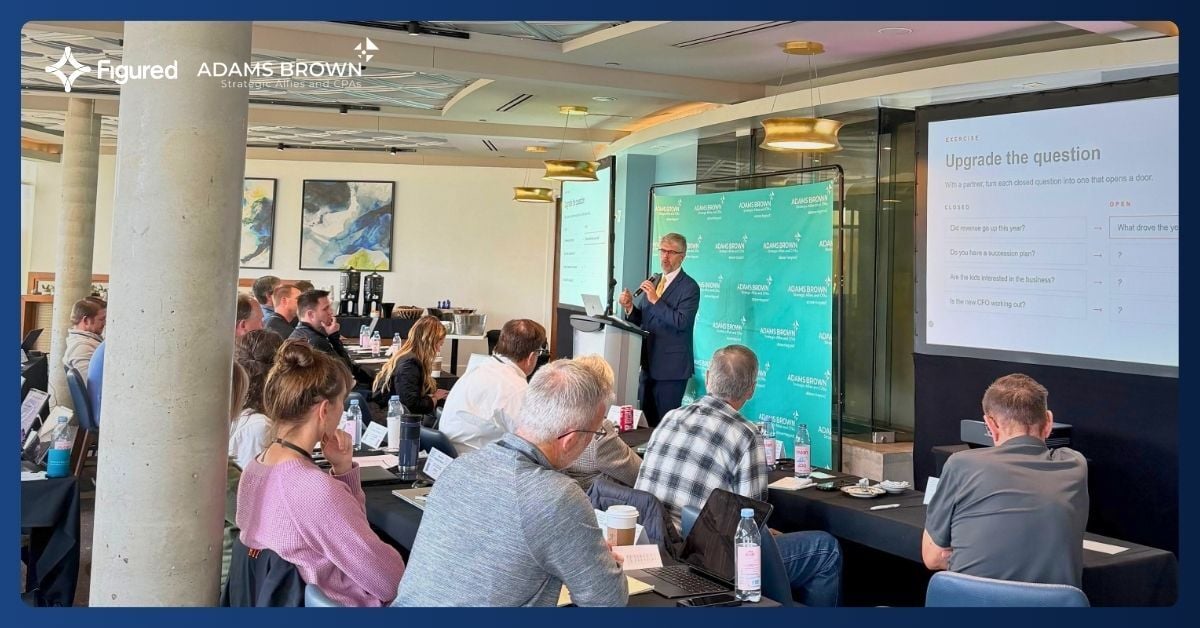
Over two days in Kansas City, Adams Brown Beyond the Harvest moved from family succession and the advisor's role in an AI age on Day 1 to a full tax and law update on Day 2.
But despite covering much of the technical side of ag accounting, the sessions kept coming back to something else: people. Farm families making decisions they'll live with for decades, and the accountants and advisors helping them through.
AI took up much of the discussion, but both days convinced us there's still a lot of human left in an AI world. The decisions that stall a farm business are often family ones, and the person best placed to help is the accountant already sitting at the kitchen table.
So what are our big takeaways from the event? Here's the full report.
1. The Hardest Farm Decisions Sit Outside the Spreadsheet
When a farm family puts off succession, expansion, or winding down, it's often personal reasons holding them back - the kinds of things that don't get brought up in meetings.
In his session on succession, Lance Woodbury of Pinion Global noted that money and readiness are the concerns clients voluntarily raise. The bigger questions go unmentioned: whether the business can run without the senior generation, whether the family will hold together, and what the older generation will do with themselves once they step back.
An advisor who can see the family, the business, and the ownership questions together is the one who can raise those questions with the family before they're a barrier.
Learn more: How Pinion Built an Advisory Practice That Moves at the Speed of Modern Ag
2. The Tax Outcome Is Often Set Years Before the Transition
A retiring farmer tends to see the operation as one business and one life's work. Roger McEowen of Washburn University School of Law spent much of his Day 2 session on the gap between that view and how the tax code treats an exit instead, asset class by asset class. With around 82% of farm sector assets tied up in illiquid real estate, a family that exits without a plan can face a tax bill it has no cash to cover.
The family has to make many of the choices that shape that bill well ahead of time, such as how it structures its entities, or whether assets pass through a lifetime sale or at death. McEowen's advice was for CPAs and attorneys to review structures and coordinate early.
But a family only considers those options if someone raises them while the senior generation is still ready to act. Accountants see a client's numbers often enough to know when that window is opening.
Learn more: Built for the Bank, Not the Business: What Most Farm Budgets Get Wrong
3. Succession Is a Process, and Someone Has to Keep It Moving
Lance drew a line between the estate plan, which moves wealth between generations, and succession, the slower work of two generations agreeing on where the business is headed, who does what, and how that's rewarded. Calling both a "plan" makes succession sound like something you finish, and momentum often fades once the family signs the documents.
His advice was to find the client's first next step, perhaps a family conversation, or a projection of retirement income, and then ask for their blessing to keep following up on it.
That follow-up fits the regular rhythm accountants already have with their clients, which makes them one of the few people in a position to keep each step moving and hold the family to what it agreed.
4. AI Is Absorbing the Technical Work
In his session on the advisor's role in an AI age, Lance split an accountant's work between what software can now handle and what still needs a person.
Yes, software is getting good at the numbers side - preparing returns, reconciling books, that type of thing. But earning trust over years, understanding, empathizing, and guiding families through the big moments ... that can only be done by a person. AI lacks the human nuance to know how to choose words carefully, and when to time difficult truths.
As the technical work gets faster, those emotional skills will make up a larger share of what clients pay an accountant for. The hours AI saves on preparation can go into the room with the family.
Holding the Trusted Seat
Accountants already have the trust they need to adapt to a changing ag environment. They talk to the owner every year, they see the business, the family, and the money together, and clients see them as an objective, trustworthy voice. In fact, many accounting practices have worked with several generations of the same family.
That trust is what lets them raise hard questions early, preempt hidden barriers, and keep the family moving forward.
AI will take on more of the technical work, and this is a good thing. It'll free up more time to have better, deeper conversations, across more clients than ever before. But those conversations still run on numbers, which QuickBooks can't handle on its own. That's where Figured comes in.
Learn more about how Figured is helping US ag accountants turn their insights into actions, connecting the file and the farm together in real time so conversations can start looking ahead - at scale.