By Forsyth Thompson
Harvest is when the year’s numbers finally come in, and it won’t be long before the bank wants to see them. With lenders more cautious than they used to be, here’s what it takes for a row crop farmer to walk into that meeting bank-ready.
Rising input costs and squeezed margins are proving the biggest concerns of most American farmers (AgriWebb 2025). In this climate, your farm can’t afford to miss an opportunity at the bank.
Still - easier said than done, especially mid-harvest.. When you’re already the farmer, mechanic, parts-getter, boss, admin, spouse, and parent, you don’t have time to also be the accountant. Unfortunately, outdated balance sheets and inaccurate cost estimates can lead to poor-quality loans, high interest rates, and, worse, rejections.
This is where it’s critical to get the right advice. The ‘do it yourself’ days have passed: modern American farmers can’t go it alone, especially when it comes to their finances.
Jonathon and Holly Haralson have worked hard to solve this exact problem at Empire Ag, their full-service farm advisory firm based in Texas. In a free on-demand webinar, they shared their advice about profitability, market volatility, and most importantly: getting bank-ready as a row crop farmer.
In this article:
Why Are the Banks Turning Away Farmers? Because Volatility Kills Generosity
Every farmer in the country knows things are tight - and the banks know it too. Costs are up, prices are down, and institutions like CoBank have outright said they’re anticipating more loans to fail (in fact, 36% more farms filed for Chapter 12 bankruptcy in the first 9 months of 2025 than all of 2024) (Reuters).
Now, this isn't a doom-and-gloom article, but it's important context - risk is high.
“With the extreme volatility that we’ve seen, the high interest rates, it’s put pressure on our cash flow position,” explained Jonathon. “A lot of these bankers are starting to retreat and walk back from agriculture.”
“They look at row crop farming and say, ‘Hey, I know that you’ve had an operating note of a million dollars for the last five or six years, but we’re going to cut you back to 750 and hope that you can do it. It’s not based on anything other than their gut reaction to what’s going on.”
So if the pressure is piling and the cashflow isn’t flowing, what do Jonathon and Holly recommend to their row crop clients?
1. Un-Hide Hidden Costs
One of the first things to discuss is how hidden costs can impact your break-even price without your even knowing it.
“I would ask [farmers], what do you got in your corn crop?” Jonathon explained, “and it’s $700. And so, what does that $700 actually entail? Typically they're just quoting their direct costs: seed, fertilizer, that kind of stuff. But nobody ever accounts for the property and casualty insurance, the trips to town for the parts. It’s all the stuff below, and that affects that breakeven price.”
That number matters most right now. Whether you’re selling off the combine or deciding what to put in the bin, your break-even is what that call rests on. Accurate records help get banks on-side. If they think you’re making decisions based on bad information, they may not believe that you can handle a new loan.
Real Farmer Story
A producer recently came to Jonathon who had his breakeven price on corn worked out at about $3.15 per bushel, but hadn’t factored his indirect costs - which added $1.15 per bu.
“ So, profitability-wise,” said Jonathon, “in his head he thought ‘We're in a great spot - I can market my corn.’ But when we got to looking at it, it was a whole lot tighter than expected.”
With the client’s true breakeven sitting at $4.30, this drastically changed his marketing plan.
2. Check if Your Balance Sheet is Lying
For some farmers, their balance sheet is lying to them - and it’s changing their position at the bank.
Jonathon had another story about a real American farmer facing this issue:
Real Farmer Story
Empire Ag had a new client with $2.4 million on his balance sheet, and whose bank had him listed as a ‘distressed loan’. But this wasn’t entirely accurate.
Jonathon’s team investigated the problem, obtaining actual appraisals on all of the client’s equipment plus real estate, then applying a conservative 80% loan-to-value assumption - and it came out to $4.2 million. That’s $1.8 million in missing value.
The client’s debt-to-asset ratio dropped from ‘distressed’ to a healthy 48%.
“We ended up changing banks with this client. He didn't have time to mess with it - he could have done his own spreadsheet, but why? With Figured, we pull those QuickBooks files, adjust them, run the reports, and get him answers fast. We closed that financing deal in seven days.”
3. Don’t Ask Nicely - Show Up With a Plan
Banks don’t want requests - they want to meet farmers who’ve done the math.
When you’re stuck in spreadsheets, this isn’t easy. They get too big, formulas break, and it takes hours in the office each week just keeping it all up to date.
But when you get your farm into ag-specific financial management software like Figured, with a top-tier advisor like Empire Ag on call (more on this below), it does a lot of the work for you.
And the cool thing is, in Jonathon’s experience, this really works…
Real Farmer Story
A young farmer came to Empire Ag wanting to buy out his father and uncle - a $1.2 million purchase that would have been hard to justify at first glance.
Jonathon explained that you can’t just show up at the bank and say ‘Hey, I’m gonna buy my dad and uncle out.’ When Empire Ag goes in, they roll into the bank and say, “Here’s our plan. We’re going to borrow $1.2 million extra. Yes, it’s a lot of money, but we understand where we’re at and this is our goal to get there.”
The key was showing how the math actually worked. The purchase brought in $2 million in assets, created another $1 million in equity, and dropped the farm’s debt-to-asset ratio from 72% to 48%.
This wasn’t a young farmer overextending - it was a smart young operator with a solid plan, backed by provable numbers.
What a Bank-Ready Profile Looks Like
When you walk into the bank, they’re going to look for six things. With harvest numbers fresh, now is a good time to ask your accountant to help you get these into an easy-to-maintain profile so you're ready to talk about finance whenever you need it.
Building Your Bank-Ready Profile
- Current financial statements: Not just tax returns, but accrual-basis P&Ls and balance sheets.
- Your real net worth: Updated equipment values, current land appraisals. Basically, all farm assets and liabilities, calculating total farm equity.
- Multi-year history: Consistent financial records for the past 3-5 years.
- Crop-by-crop breakdown: Something to prove you’re making informed decisions about crop mix - like a report on your most profitable crops.
- Cashflow projections: Month-by-month projections showing the money you need, when, and how soon you can pay it back.
- Up-to-date collateral lists: Current equipment lists with fair market values, land appraisals or assessments, plus grain inventory statements.
Keep in mind you don’t have to handle this alone. If an expert can help you find $1.8 million in missing value, that’s advice which pays for itself.
Learn more: Doing Everything Yourself to Save Money? It Might Be Increasing Your Costs
How Empire Ag Does It
Putting it all together, getting bank-ready as a US crop farmer is about having the answers when bankers ask the questions. Now - not in two weeks.
That’s why Jonathon and Holly use Figured to get the full picture across their client base, and to access those real-time, detailed insights banks want.
"I can almost remember to the day when we discovered Figured," said Holly. "It was like, oh my gosh, this is it. And it's just been so nice to get off the spreadsheets, get off the pen and paper, get off the napkins, and actually be able to put some useful tools and information out there that you rely on and that you have confidence in."
Where Figured Comes In
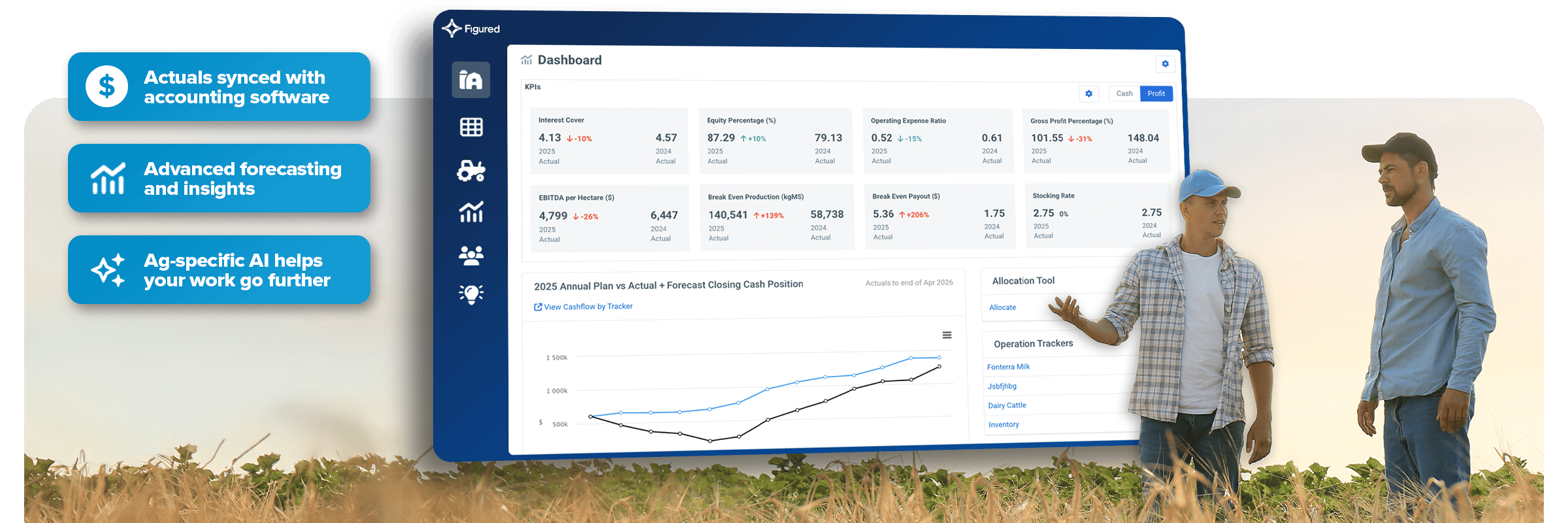
For Empire Ag, Figured integrates their clients’ production data with their financial software (like QuickBooks). This enables live visibility into each client’s actual financial position, pulling directly from what’s really happening on the farm.
"When I'm on the Figured side," Holly added, "you can click right into a number that you're looking at and you're like, this just doesn't look quite right, and it'll take me right back to our QuickBooks file and we can dig in deep. It's instantaneous."
"The beauty of the integration is that there's no hiding from the numbers,” added Figured panelist Mitch. “It's what's been reconciled. It's what's in the bank account. There's no, 'I spent maybe $3,000' where you can pull it up and go, 'actually, you spent $4,200'."
For farmers working with Empire Ag, they can walk into their bank with confidence because they’re backed by provable data that shows they’re on top of their operation.
Learn more about how Figured is helping American crop farmers. Or, download the free Farmer Starter Pack to see more about how to get started.