.png)
By Forsyth Thompson
It’s one thing to plan more advisory services as an agri accounting firm. It’s another thing to find the capacity to handle the client load. Here we look at how to plug that gap—without just ‘hiring more’.
You know your livestock clients are making major financial decisions without your help.
You know you want to do more advisory to capture and own those conversations.
You know it’ll help build long-term, year-round relationships while adding more revenue (our research suggests advisory and planning add-ons could generate over 300% revenue uplift—more on this below).
But there’s a problem: capacity.
Capacity constraints are an industry-wide challenge and it’s holding agri accounting firms back.
Let’s talk about solutions.
In this article:
→ Why hiring more doesn't solve the problem
→ How to build real capacity
→ Implementing change which sticks
→ Where to learn more
Why ‘Just Hire More People’ Doesn’t Solve Things
“In our industry, everyone is in the same boat,” said Flor-Hanly director Tony Olsen in our recent webinar. “It’s frustrating in the public practice world because we’re so limited with capacity. Typically we’ve got more work than we can handle [...] and we’d love to do this high-value strategic advisory type work but we’re limited.”
But, hiring more people doesn’t always solve things.
If you’re operating with a legacy system that’s already straining, adding more people just equals a more expensive strained, legacy system. When a client calls on Friday afternoon about an upcoming property auction across the road, another accountant won’t solve the real problem.
The bottleneck isn't in headcount—it’s the two weeks it takes to pull the numbers to get something meaningful together.
“The traditional approach of building that in what we used to do, in Excel-type spreadsheets, would kill you,” joked Tony.
Fundamentally, if the system is too slow, hiring adds overheads without bringing in new revenue.
How to Build Real Capacity (Not Just Headcount)
At Flor-Hanly, Tony and the team solved their capacity problem by focusing on three improvement areas:
- Technology
- Pricing
- People (to an extent)
1. Technology
Fast advisory solutions require fast insights.
For Flor-Hanly, that’s meant integrating Xero and Figured into their processes so that client data flows automatically into their models from both the financial and production side.
“We’ve been working with clients using Figured on a regular basis,” said Tony, “and we’ve got live models or cash flows sitting in there. It’s very quick for us to go to the model, add in the property purchase, and get something meaningful done quickly for the bank and for the clients to make that decision.”
What That Looks Like in Practice.png?width=300&height=300&name=Tony%20Olson_Flor%20Hanly%20(2).png)
Tony’s team have been working with Queensland cattle producers who were being heavily penalised for their high Brahman content cattle.
“We’ve had clients that have been traditionally selling more around feeder weight cattle high in Brahman content who have been hurt badly in the saleyards.”
“When we’ve sat down and modelled up, ‘how do we get your herd to the right mix so that you can actually take them through to hooks and not get penalised?’, we were able to work with them and their banks to arrange carry-over finance to get there and increase their profitability.”
That kind of strategic planning—modelling breed mix changes, coordinating with banks, projecting the profitability impact—would have been impossible with the old Excel approach. But with live data feeding automated models, it becomes a conversation, not a two-week research project.
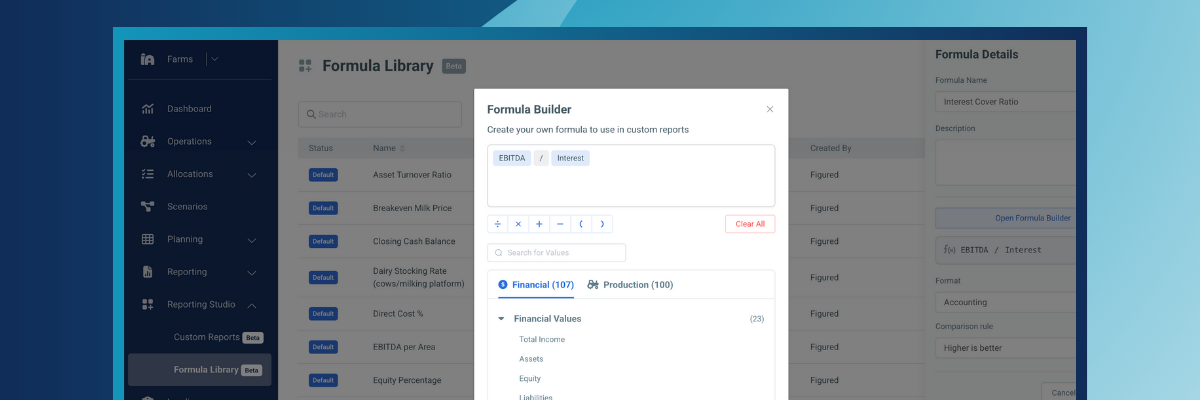
Plus with Figured's new Reporting Studio, accountants like Tony can build highly flexible farm reports using live data and custom formulas, then turn those reports into reusable drag-and-drop templates. The result? Quarterly reviews and bank packs that once took days deployed in minutes instead.

2. Pricing
Next, price also has a role to play. Almost all of Flor-Hanly’s clients have been swapped over to an upfront pricing model, ensuring clients don’t hesitate to call.
“We encourage our clients to call their accountant or whoever they regularly deal with in the office before they make big decisions,” said Emma Olsen, Tony’s co-owner. “We feel it helps us help them better. It becomes part of the rhythm.”
When clients aren't worried about a big invoice, they call earlier. Getting that call now means solving smaller problems before they've had a chance to grow. There's less working backwards to untangle mistakes, and more working forwards, on a month-to-month basis, to carefully plan cost-effective business decisions.
Worried some clients won’t go for a new pricing model? Read more about how Precision Advising’s Ashly Lindberg found power in saying “no” to clients who wouldn’t budge. See the full story.
3. People (To An Extent)
People might not solve the problem alone, but tactical hiring can still form a core part of the solution—if you can find the talent.
“We were pulling our hair out not very long ago,” said Tony. “Probably about five years ago, we made the decision that we’ve got to stop saying ‘we just can’t get people’ and actually go do something about it.”
Instead of battling other accounting firms for the limited supply of Mackay-based talent (and agri-specific accounting talent at that), Flor-Hanly looked to remote and offshore talent.
They’ve taken on a number of remote staff around Australia as well as 11 offshore team members in the Philippines—who handle the compliance work while freeing senior staff to focus on the high-value advisory side.
Learn more: Do Clients Care About Offshoring? How To Have Those Conversations
In short: Capacity doesn't come from more people working more hours. It comes from smart automation and tactical hiring handling compliance work, freeing your senior team to deliver faster advisory services with real-time insights.
Implementing Change That Sticks—And Doesn’t Blow Up
Anyone who’s tried change management before—especially at this level—knows it’s not easy. If you were to roll this out to your entire team on Monday morning, you’d be right for thinking it might blow up.
People like to work the way they’ve always worked. Success in change requires a more careful approach.
“We found it very helpful to find one or two people internally who became champions for onboarding into Figured, learning how to use it well and taking that time,” said Emma, explaining how Flor-Hanly managed at their firm. “I’m not 100% confident that just throwing it out to your team and saying ‘use Figured’ is going to get the results you want."
For example, one senior accountant on the team put up their hand to be trained in the use of these new tools. They made the mistakes, built the confidence, and figured out what was going to have to change before it disrupted anyone else’s day-to-day.
“There's an upfront investment in being good in the software that will have flow-on benefits,” added Emma.
Our tip? Start small, with just a 3-client test:
- Pick clients who already have good Xero bookkeeping.
- Implement quarterly strategic reviews with just those 3.
- Prove the model works before scaling.
Learn what needs changing when the stakes are low. Then expand.
The Revenue at the End of the Tunnel
This level of change might take time, even years for larger firms. And that initial disruption phase might sting; your people bring in the revenue, and they need time to adapt. Flor-Hanly found the same. It’s normal.
But over time, the needle starts to shift. Training reduces disruption. Disruption becomes day-to-day. The day-to-day becomes streamlined. Clients start to see the benefits—and then they want more.
In fact, our research, done in collaboration with Xero, shows that when accountants shift from compliance to advisory services their perceived value among clients can jump from 23% to 83%, and revenue uplift can go as high as 327%.
Yes, the capacity trap is real, but so is the way out
Learn More About the Real Framework Behind Success in Advisory
Flor-Hanly is one of a growing number of Australian accountants and advisory firms built on a 3-part framework that allows their team to respond to livestock decisions in hours instead of weeks.
Each step builds on the other, helping you connect in real time as a farm team, look ahead (not just behind), and create longer-lasting, higher-value relationships. To maximise success, you can’t just do one—you need all three:
- Continuous visibility: Building a real-time connection between livestock movements and financial positions, gaining instant visibility of where your clients are at any time. Read more →
- Forward planning: Creating forward-looking plans and modelling scenarios as opportunities arise, adjusting course as markets shift. Read more →
- Proactive touchpoints: Creating regular touchpoints with clients, using current data, focused on forward decisions. Read more →