When a client calls after harvest asking whether to sell, they need an answer while the price is still there. A good answer starts with one number: what each bushel cost them to grow. QuickBooks can't give you that number on its own, and it's worth being clear about why.
QuickBooks Online is very good at transactions. Seed and fertilizer invoices, fuel, repairs, interest, and grain checks all land where they should, and with classes set up carefully you can split some of those costs by crop. What it has no way to record is the farm itself, like acres planted, bushels harvested, bushels still in the bin, and bushels fed to the farm's own cattle.
To work out cost per bushel, you need both halves.
Clients are asking what their crop cost, and how much of it there is. Without the production side there's no break-even, and farmers are left making sell decisions on gut feel and last season's spreadsheet.
Direct Costs Are Only Part of the Number
Most growers carry a break-even in their head, and it's usually built on their direct costs. But, for many American farmers, this number can actually hide most of the story.
Jonathan Haralson, CEO of Empire Ag, spoke to us about a producer who was in this exact situation. He felt ready to market his corn, but his indirect costs were missing from the equation.
"So profitability-wise, in his head, he thought 'we're in a great spot, I can market my corn'," said Jonathan. "But when we get to looking at it, it's a whole lot tighter right now than what he was expecting."
The producer’s direct costs came to $3.15 a bushel. Adding $1.15 of indirect costs took his full break-even to $4.30, which left him essentially at break-even at the price on the day.
Indirect costs like machinery, labor, interest, and land don't belong to any one crop, so you have to share them out. A common way is per acre across every crop, applied the same way each year so the numbers compare from one season to the next.
Learn more: Harvest Numbers Are Coming In. What Your Row Crop Clients Need From You Next
The Same Cost Lands Differently on Each Crop
In our recent webinar series with Insightful Accountant, we used a fictional Nebraska farm to show how this plays out. 'Tom Brandt' harvested 273,000 bushels of corn. He sold 110,000 at the elevator, fed 18,000 to his own cows, and still had 145,000 in the bin, along with 22,000 bushels of soybeans.
On direct costs alone, Tom's corn breaks even at $2.87 a bushel and his soybeans at $5.00. But indirect costs push both numbers up, and this is where his crop mix matters. Tom's corn yields far more bushels an acre than soy, so the same indirect cost per acre adds much less to each bushel of corn than to each bushel of beans. At $100 an acre, that's about 51 cents on corn at 195 bushels an acre, and about $1.67 on soybeans at 60.
| Illustrative | Corn | Soybeans |
|---|---|---|
| Break-even on direct costs | $2.87/bu | $5.00/bu |
| Add $100 an acre of indirect costs | +$0.51/bu | +$1.67/bu |
| Full break-even | $3.38/bu | $6.67/bu |
| Still in the bin | 145,000 bu | 22,000 bu |
Illustrative figures for a fictional operation. The $100 an acre indirect cost is an example only.
If Tom's advisor had this level of full break-even for each crop, they would be able to sit down and talk about margins on every bushel still in the bin at today's price, and what a 20 or 30 cent move would do to it. That's the conversation to have before a client calls the elevator.
What it Takes to Answer the Sell Question
You don't need every field mapped to get to this level of detail. To give a client a break-even they can act on, you need four things in the file:
- Acres, yield and bushels on hand, by crop.
- Direct costs allocated to each crop.
- A consistent way of sharing out indirect costs.
- Break-even per bushel on direct and full costs, updated as prices move.
Learn more: Figured for Crop Advisors
Where Figured Fits
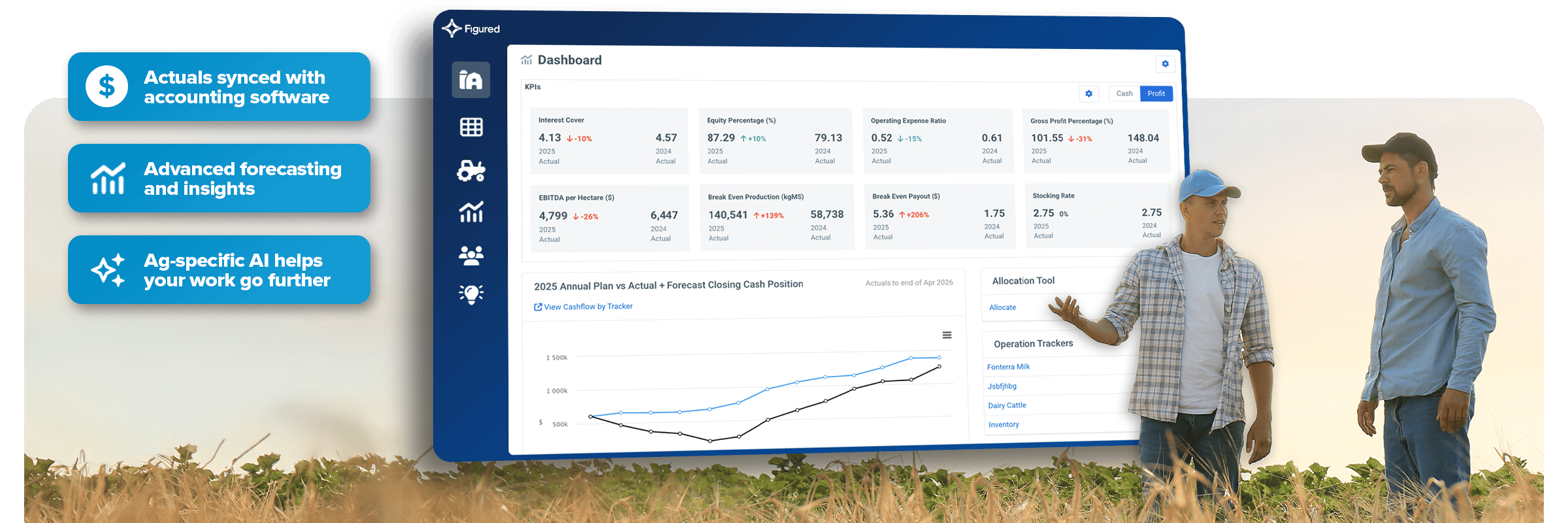
Figured sits alongside QuickBooks Online or Xero and holds the production side the ledger can't.
Crop Trackers record acres, yields, sales, and grain on hand for each crop, and the Allocator splits costs by crop or by field. Figured also puts a value on grain fed on farm, so the crop and the cattle both show their true numbers. Break-even is one of the ready-made formulas, and once you've set it up it's scalable across every farm you look after.
Jonathon and Holly Haralson walk through how they do this for their own clients in How to Master Row Crop Finances, which you can watch on demand.
For more reading, learn how JC Ag Financial Services scaled to service over 110 clients across America using the same standardized, repeatable workflows in Figured.
Mitchell Parks and Erin Arick have helped partners like JC Ag and Empire Ag get started, and they're happy to talk it through for you and your farm clients too. Book a conversation with Mitchell or Erin.
Or to see how Empire Ag built its advisory practice around this, download our free guide, From Compliance to Advisory.