Overview
Farming is a specialist job, run by a specialist team — spreadsheets weren't built for either.
Figured was built by two accountants who were also farmers, who needed something better than spreadsheets to answer the same questions you face daily with clients.
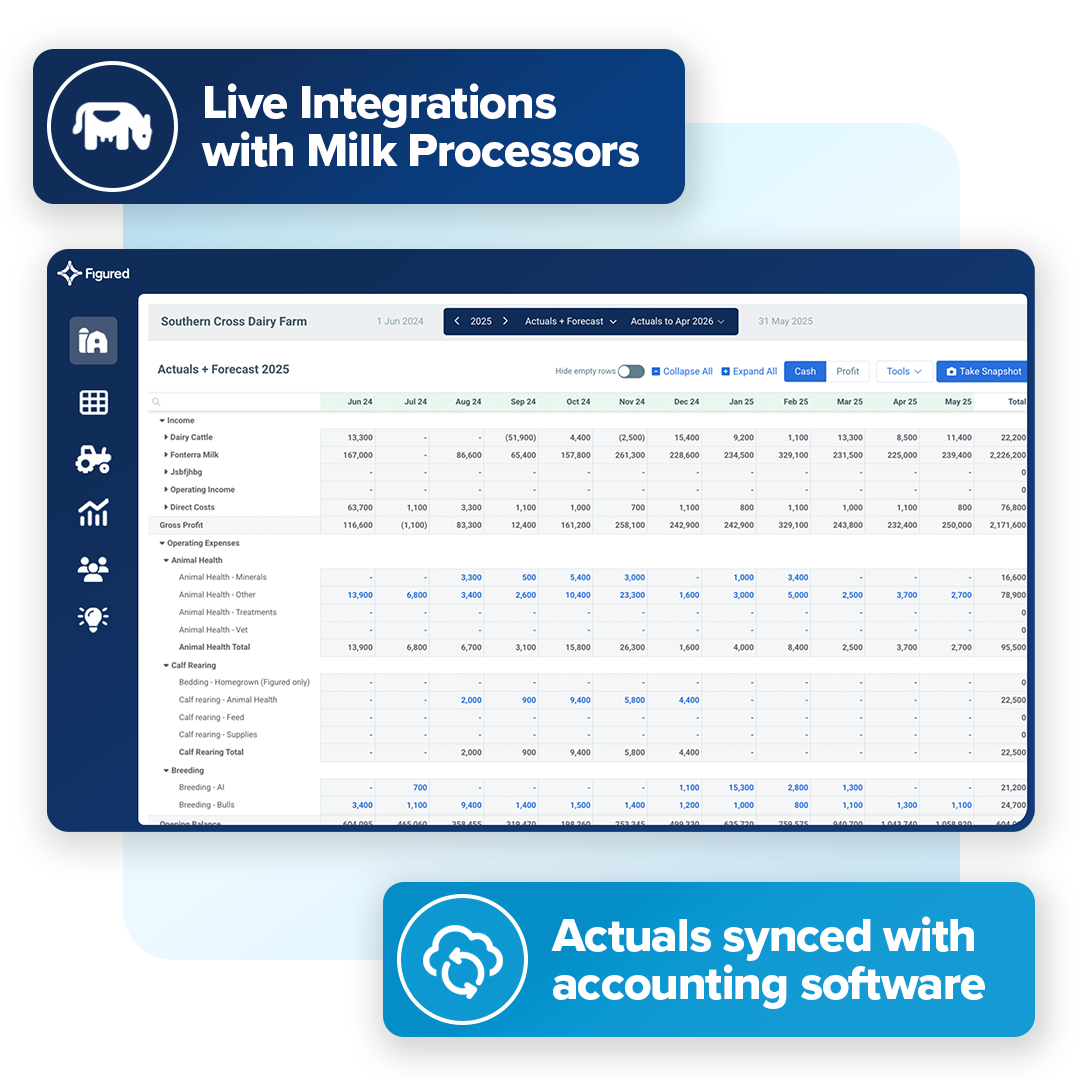
Today, Figured is the world's largest ag financial management platform, connecting the farm's accounting software directly to on-farm activity so accounting and production data sit in the same place, in the language and metrics of farming.
It's structured specifically for the way US farm teams work, giving farmers, accountants, advisors, and the bank a shared working view, so everyone always knows where they stand and can plan with confidence.
Spreadsheets
Spreadsheets are the familiar option, and most farm teams start here. They can hold almost any number in almost any shape, making them infinitely customizable — but that flexibility comes at a cost: a spreadsheet is a static, point-in-time snapshot, already out of date by the time you've finished building it.
Every update, correction, and reforecast depends on someone finding the time to redo it by hand, so you're never quite sure you're looking at where things actually stand today.
Compare
| Capability | FiguredAg Financial Management | SpreadsheetsManual, General-Purpose Tool |
|---|
See what Figured can do for your unique business.
Book a DemoData Sync

Collaboration

Scalability

I can almost remember to the day when we discovered Figured. It's just been so nice to get off the spreadsheets, get off the pen and paper, get off the napkins, and actually put some useful tools and information out there that you rely on and have confidence in.
I didn't have a lot of confidence in my spreadsheet and my formulas. Whereas with Figured, I know they're all over that. It gives me a lot more confidence to know that the actual figures being pulled through are correct — and they're getting pulled through in real time.
With Figured, I feel like it gives you a bit more clarity going forward. Running the numbers takes the guesswork out of forecasting — if you change one figure, it flows through to the next, so you're not wondering if your spreadsheet formula's correct. My advice for other farmers: get on board, have a try. It'll give you a lot more confidence and a lot more time.
Questions
Your budget is rebuilt in Figured rather than imported as-is, but with an important caveat. Figured can import last year's actuals from your accounting software directly into this year's plans, so you don't have to start from a blank grid.
Then, production information, where it exists, can be imported into the relevant production tracker, which you can also build from last year's actuals. Once both are in place, you'll have the bulk of what a spreadsheet budget would typically contain, already sitting in Figured before you've entered a single new line yourself.
It depends on how much history you're bringing across and how many farm activities need tracking, so there's no single answer that fits every farm. The technical side moves quickly; for example, connecting to Xero or QuickBooks Online takes minutes, and most livestock app connections sync within about 10 minutes once verified.
The part that takes more care is getting the farm-specific setup right the first time. That's your chart of accounts, stock classes, and production trackers, configured to match how your farm actually runs.
For farmers, this is one reason we typically recommend getting set up via a Figured-certified partner — trying to do it without an advisor tends to mean a slower start and more things to unpick later. For accountants and advisors, our team can help you get set up.
Don't have an accountant? Check out our trusted partners:
Yes. Figured shows one live version of the farm's numbers, and everyone with access, whether that's a farmer, trustee member, accountant, or bank, looks at the same one. There's no one working from an emailed file that went out of date three weeks ago.
When you want a record of how the plan looked at a point in time, simply take a snapshot. Snapshots can't be edited once saved, so they become a real, locked record of what the plan said on that day, which you can look at any time to compare in future.
Figured is built for the whole farming team, including farmers.
Most farms get the most out of Figured when both sides are using it. The farmer's role is keeping the underlying data current, for example reconciling in the accounting software and recording farm activity as it happens. The accountant's role is configuring the trackers, managing the planning and reporting, and handling the year-end work that needs their expertise.
When both sides are doing their part, the conversation moves from what happened last season to what's happening right now — and what should happen next.
Figured's Planning Grid is actually built to work a lot like spreadsheets. You enter forecasts cell by cell, budget on a cash or accrual basis, and structure accounts the way that suits the farm. That said, you can't build an entirely custom layout from a blank sheet, because Figured's structure is what enables production data, actuals, and reports to all connect to the same plan automatically.
If you're used to formulas that combine financial and production numbers, the Planning Grid's dynamic calculation tool covers the same ground. Instead of typing a fixed number into a cell, you can set an expense or income line as a percentage of another account, or as a dollar amount per acre or per stock unit — and the forecast updates automatically as those actuals change through the season.
Custom formulas, columns, and tables are also a major component of Reporting Studio, Figured's AI-enabled custom report builder. Here, flexibility is the point, allowing you to build the report template that best suits your clients once, at the organization level, and roll it out across individual farms with the numbers updating themselves.
Figured is priced as a monthly subscription per farm file, managed usually by the accountant. There are two tiers: Farm Reporter for real-time compliance reporting, and Farm Manager, which adds planning, cash flow forecasting, and variance reporting.
Accountants typically hold the subscription and manage it on behalf of their clients. How they pass that cost on — whether itemized separately or folded into advisory fees — is a practice decision.
For a clear picture of what the right combination would cost for your farm team, visit our pricing page.